Showing posts with label Elite. Show all posts

Wednesday, 18 January 2012

Kokotoni Wilf (ZX Spectrum)

I've played some games with some stupidly-named heroes in my time. I've played Nodes of Yesod. I've played some Final Fantasy games, if only briefly. I haven't really played a Zelda game, but I know they've got some stupid names. It's kind of expected that characters will be named unconventionally. But what on earth would posses you to name your hero Kokotoni Wilf?

Released in the front half of the Eighties, Kokotoni Wilf was the first ever release from renowned company Elite. It's very highly regarded among Speccy owners, and indeed, I remember quite enjoying it at a friend's house. So in an off-period, having trawled through my archives, I thought I'd play it again for the first time in over twenty-five years.
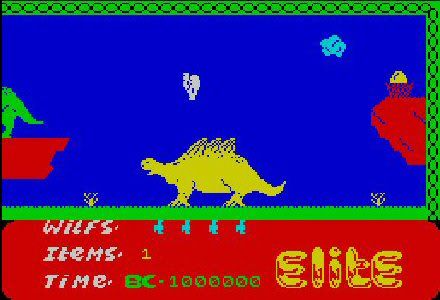

I'm sure I've seen better dinosaurs on the wall of my kid's classroom.

Kokotoni Wilf is the poor, put-upon assistant of Ulrich the Magician. Ulrich is apparently so powerful that he is able to keep all the dangerous dragons of the world asleep. The spell, though, is about to expire, and Ulrich must renew it. Unfortunately, the powerful Dragon Amulet, a might artifact essential in casting the spell, has been broken and scattered across time...

That seems a bit irresponsible to me... how could you let something so important get smashed to bits? Anyway, Ulrich might be powerful, but he's also old and apparently his spell repertoire does not extend to magically collecting the pieces of Amulet, so it's up to Wilf to get out there and physically do the job.
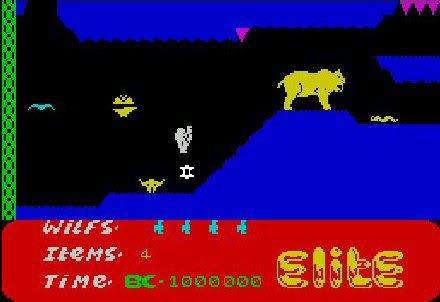

Someone explain to me how that big thing got in this small cave, please.

It's a tricky task, so to give his manservant a bit of a hand, Ulrich give Wilf a pair of magical wings, so he can get to those tricky to reach spots. These will come in handy in your passage through time... jumping over dinosaurs and the like could be a bit beyond a man!

I can't say I remember just why I enjoyed this so much back then. I mean, I had an Atari 2600 which had considerably better sound than the Spectrum. And it's a very hard game to love on appearances. Initially, it looks like something a primary school class conceived and drew, with bright primary colours splashed across childish-looking characters.
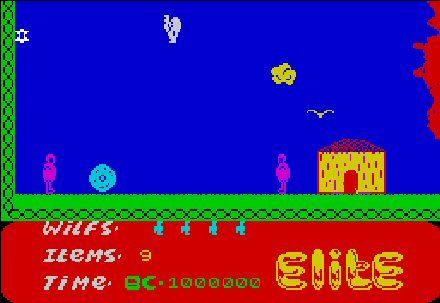

Yeah, nice work, smarty-pants. Icarus could do that too, and where did it get him? Eh?

And then, the gameplay itself is terribly slow. For all he's got wings, Wilf limps around from screen to screen with all the urgency of a crippled sloth, which doesn't make the game very exciting.

For all that, though, there's something quite compulsive about Wilf's hunter-gathering exploits. Maybe the trip through time has something to do with that; or maybe it's that urge to see what's on the next screen (for better or worse). Maybe it's just that you don't want to be beaten by its infantile creations.
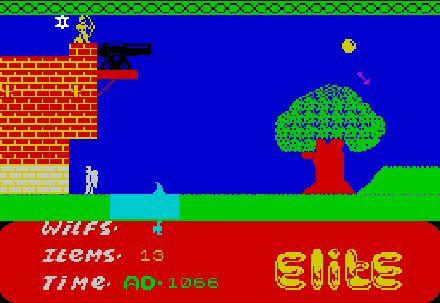

There you go, old reviewers... three games and I'm onto 1066AD. It's not that hard...

Kokotoni Wilf picked up all kinds of awards on its release, and even to this day is rated very highly on the excellent World of Spectrum website. Those rose-tinted glasses must be prettyy powerful, because it's really not that good. But it's not a dead loss either, and in those days when imagination counted for more and we were more prepared to imagine ourselves in a dinosaur-filled wonderland, I expect it was fairly easy to lose a good few nights after school to this.

As a kind of postscript, I had a read of the reviews for this on World of Spectrum, and was quite surprised to find that a fair number of them appear to have been written by people who couldn't be bothered to play the game properly before reviewing it. A few reviews mentioned not getting past the dinosaur section, which was only twelve or so screens of a sixty-screen game. To be fair, I haven't played it properly either, but at least I put a bit of effort into it, and it's not that hard. It gives you an even greater appreciation for the skills and application of the ZZAP! lads (and by association, the CRASH lot as well). I suppose a lot of games were released back then and time was at a premium, but it explains why ZZAP! 64 and CRASH were so far ahead of the rest... they appear to be about the only ones who actually enjoyed playing games!

Friday, 26 March 2010

FIGHT! Commodore 64 vs. ZX Spectrum. Number 1: Bomb Jack

Here's a feature I thought would be a good idea, that would tap into our schoolyard memories and provoke, erm, "discussion"... ZX Spectrum vs. Commodore 64! We've all had those arguments as to which is better... and I felt like stirring the pot a bit more. Just for argument's sake.

Now, I owned a Commodore 64, but I'm perfectly able to accept that it might not have had the best version of every game. I thought it might be fun to take a game that was released on both, put them up against each other and see which is better. Let's see how it goes...

The first game I chose was Tehkan/Tecmo's Bomb Jack. OK, so it's an arcade game, and that being the case, why did I choose two no doubt inferior versions to look at? Even stranger... Bomb Jack is not a game I have any particular love for. I've never been any good at it, and I find it quite frustrating. And yet, I've subjected myself to it... twice.


Here's what we started with... lovely, juicy bombs.

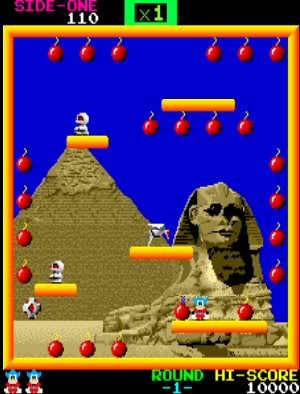
The arcade game is actually quite nice. It's pretty enough... bold and colourful, with those lovely red cherry bombs hanging in blue skies. To get the best scores, you have to collect the bombs in order. Once you collect one, the next in the sequence will start flashing. That's the one you should go for. Collect all the flashing bombs and you'll receive a big points bonus.

It was never a favourite of mine; I never was any good at it. Playing it in MAME these days has given me a new appreciation of it... skilful play can see you weaving in and out of enemies, and it can get pretty intense. And of course, there's the risk/reward aspect of collecting the bombs in order for bigger points. It's a classic name, and in retrospect I would say rightly so.


Bit naughty, putting all that red in the background. Where are the bombs?

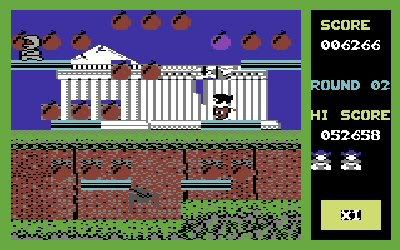
I had Bomb Jack on the Commodore 64... I did play it a fair bit but it was annoying. It wasn't well reviewed either, generally speaking. I'd also heard that the Spectrum version was really good... something that's stuck in my mind all this time, and partially led to this little feature.

Playing the 64 version again just brought home all its faults, but magnified this time. Jack's a fat lad, for starters... and oddly, you can actually feel the weight! Jack seems to drop more quickly than in the arcade version, and also seems to struggle to get his lardy backside off the ground. The enemies are all bigger too, but it's more than just a cosmetic problem... this extra size makes the screen very cramped, and it's very difficult (if not impossible) to manoeuvre around for the bombs. It's fast... but that's also a problem, given the size of everything. Also, bonuses are very hard to come by, which is annoying... and then you find out the game has a completely different (and lower) scoring system to the arcade version. Bomb Jack on the Commodore 64 is not very enjoyable.


That bird's nothing but trouble. One peck, and you're dead.

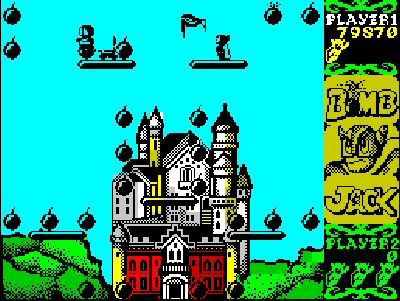
Having re-acquainted myself with the Commodore version of Bomb Jack, it was time to try the Speccy's effort. And the first thing I noticed was the size of the game's characters... they're small. Thankfully! When I say "small", I mean "just the right size". The game is perfectly playable on the Spectrum. Gaps can be squeezed through, enemies can be dodged, bombs can be collected in order, bonuses can be had. And the scoring system is the same as the arcade version's. Graphically, it's one of the nicer Spectrum efforts I've played so far, with colourful backgrounds and no sign of clashing. Nice work, Elite!

The home versions had a problem from the start, in that Bomb Jack in the arcade has a vertical monitor, and these versions had to be squashed hozizontally. One version coped with this far better than the other. I had quite a lot of fun with the Spectrum version of Bomb Jack. It's a very well implemented version of the arcade game, with precise controls and accurately-proportioned graphics. It seems as though they really took the time to lay out the screens with the horizontal aspect taken into consideration. The 64 version, on the other hand, doesn't work all that well. It does have nice red bombs, although they're more blood red than the big arcade cherries. But the poor scoring system and claustrophobic playing area really cripple it, and it's not really worth much time.

RESULT: Spectrum wins!

Wednesday, 20 January 2010

Starstrike II (ZX Spectrum)

3D Starstrike impressed me enough to want to go straight on to the sequel. And if that game got the programmers noticed for programming a great arcade game, the sequel is a different entity altogether.

It's a different game. An original game. It's an arcade game with depth. And for me, that's where it goes a little bit wrong.

Starstrike II is a very ambitious game. Rather than just give you the same levels in a set order, you must choose which planet/system you'll visit. Each area has a variety of installations to be taken out: military, agricultural and industrial. The challenges you face in each area will be slightly different, as you would expect.


Die, filled-3D alien scum!

The first problem I had was that, despite reading the instructions, I had no idea what to do. On the second stage, there's a grid with a hole in the middle. In this hole you'll find various shapes, some of which will shoot at you. It's the only way through, but no matter how much I shot stuff, I couldn't get through. Impasse!

Luckily (and I mean that literally!), after many games, for some reason I did eventually find myself past that stage, which meant I could play more of the game. And it's a pot-pourri of spacey shooting. Shoot spaceships in dogfights. Shoot installations in trenches. Don't shoot installations in trenches. Destroy the end-level installation.

It all sounds a lot like Star Wars, or even 3D Starstrike, but it really isn't. It's a more serious game. It's not as much fun. It's probably a better game than its forerunner, by virtue of its originality and ambition. But it's not as pacey... the much-vaunted filled 3D graphics are quite a bit slower than the wireframe originals, and although the Spectrum was lauded at the time for its ability to push this stuff around, the fact that it's slower takes the edge of the gameplay. I'd rather just stick with the original.

Tuesday, 29 December 2009

Star Flight (Amiga)

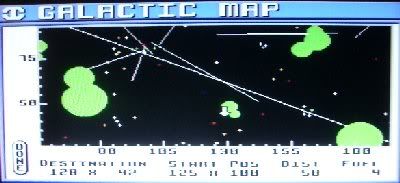
I can't tell you how long I've been wanting to play Star Flight. After The Bard's Tale had ensnared me on the Commodore 64, I had been bitten by the complex games bug, and seeing this on the C64 really piqued my curiosity. But I didn't have a disk drive at the time, and when I did get one I'd either forgotten about this or just didn't bother hunting it down. In truth, I blame Wasteland for that.

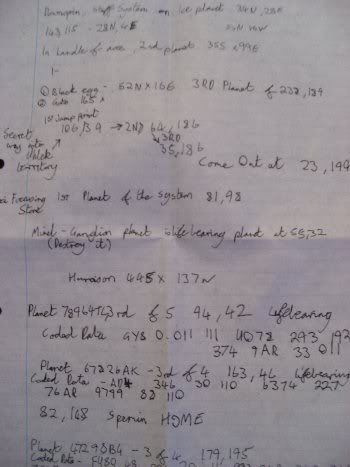
So it was with some excitement that I saw this in my Amiga pile. I was immediately put off, though, when upon opening the box I was confronted with the deranged scribblings of a confined lunatic.


Gibber gibber, scribble. Make any sense to you? No, me neither.

Actually, it's quite understandable. My mate Stephen, who gave me his Amiga, always used to write notes when playing complex games, which makes sense as you'd need to refer to or remember this stuff maybe months later on in the game. Loads of his game boxes are littered with scraps of paper that look like something that would lead you to the Holy Grail, when really they just lead you to the planet with the best mining potential in a game.

In terms of the game, it was really difficult for me to get going. What with a huge manual and code wheel, there's a hell of a lot to get to grips with, something which seemed easier when we were teenagers. And probably was, come to think of it.


The latest Missile Command world record attempt wasn't going well...

Also, the disk is filled with saved games. And there doesn't appear to be a way to start a new game, at least, not without making a new backup of the original. And I couldn't be bothered with that, either. So I set out into the galaxy in the Starship Enterprise, with Kirk and crew at large. Cheers, Stephen.

Still, difficulties aside, the time I spent in the game showed much potential. I did manage to pick out a planet on the star map, made my way there without confrontation, landed safely, drove about on the planet, mined a bit, made my way back to the ship, and took off back into the planet's orbit. Not bad going. Next will come the job of finding somewhere to sell my stuff.

Star Flight is obviously a game that you could play for years. I don't know if I'll be committing to that, but I'm happy to have finally had the opportunity to play it, and to know that it's there if I feel like having another crack at it.